
In the lead-up to International Women’s Day, more than 60 ecosystem leaders gathered in Jakarta to explore a question that sits at the intersection of business strategy and social progress: can gender inclusion generate measurable returns for businesses and investors?
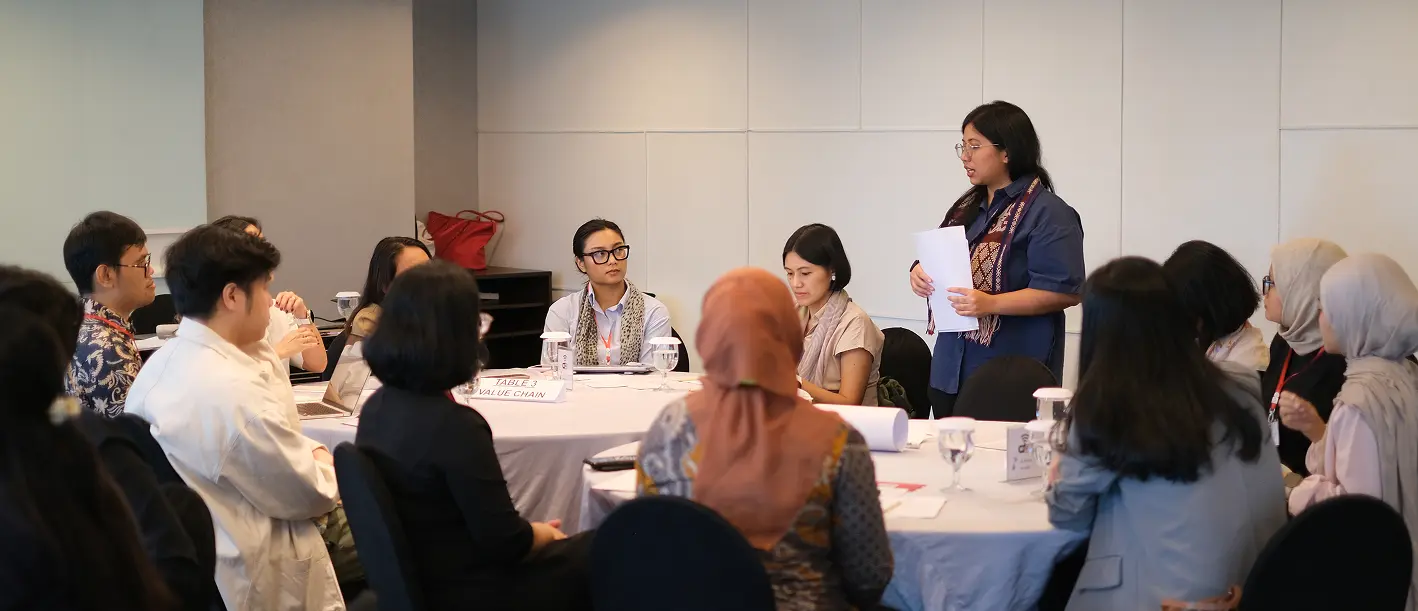
The 4th Executive Lab Forum, a collaborative initiative by KUMPUL and KINETIK with strategic support from Xendit and the Paloma Sjahrir Foundation, brought together entrepreneurs, investors, corporates, and foundations to examine how gender inclusion may influence not only social impact, but also risk management, operational stability, and long-term business performance.
“Gender inclusion is not only about representation. It is about creating systems where women can participate, contribute, and lead across businesses and markets.”
4th Executive Lab Forum, Jakarta 2026
Four dimensions, one shared question
Discussions were structured around four roundtable sessions, each examining gender inclusion through a distinct lens: leadership, workforce, value chains, and society and market influence. Two business case studies served as starting points: a regenerative cacao aggregator working with smallholder farmers, and Sun King, an off-grid solar energy company expanding clean energy access through last-mile distribution.
On leadership, participants noted that representation does not always translate into influence. Women may hold leadership roles yet have limited impact on key strategic decisions. Participants agreed that leadership diversity can strengthen governance, but only when women are actively included in decision-making processes.
On workforce, discussions highlighted that women already contribute significantly to productivity and community engagement across MSMEs, startups, and community initiatives. However, persistent barriers remain, including the burden of balancing work and household responsibilities, limited workplace support systems outside major cities, and male-dominated industry structures. Supportive workplace policies were identified as key to strengthening both participation and organizational stability.
On value chains, participants observed that women are already active contributors in sectors such as cacao and clean energy distribution, yet their roles are often informal and unmeasured. Inconsistent ESG reporting and resource-intensive certification processes remain barriers to wider adoption. Clearer incentives, better measurement tools, and stronger ecosystem support were identified as prerequisites for progress.
On society and market influence, participants recognized that inclusive business practices can create meaningful economic opportunities for women and communities. At the same time, cultural norms, safety concerns, and the absence of standardized impact measurement continue to limit progress. Participants emphasized that gender inclusion becomes more effective when integrated into core business strategy and backed by leadership commitment.
Introducing the Gender ROI framework
A central theme across sessions was the need to move beyond treating gender inclusion as a social impact or compliance issue. The Gender ROI framework was introduced as a practical tool to help organizations and investors assess how gender inclusion influences both business performance and investment risk.
The framework examines four interconnected areas: leadership and decision-making, workforce participation and stability, value chain resilience, and market and community outcomes. Through these dimensions, organizations can better understand how gender dynamics shape both internal operations and the broader ecosystems in which they operate.
Participants noted that gender inclusion may have direct implications for investment risk and long-term business resilience. The key question is no longer whether this value exists, but how it can be systematically measured and applied.
Grow Locally, Expand Globally with KUMPUL
As Indonesia’s leading entrepreneurship ecosystem enabler, KUMPUL accelerates growth by connecting entrepreneurs with strategic networks, exclusive resources, and expert insights.
We strengthen local communities while facilitating two-way global market access, helping international businesses tap into Indonesia’s dynamic ecosystem, and empowering local entrepreneurs to expand globally.
Through impactful collaborations with key industry players, KUMPUL enables entrepreneurs to scale efficiently, compete globally, and create meaningful impact.
Ready to be part of this journey? Complete this form and join KUMPUL in shaping the future of entrepreneurship!